In All Its Glory (2026)
2026 · Immersive installation · Self-initiated, solo · 2.5 × 2.5 × 2.5 m
Frame-mounted irrigation system; directional light positioned by geometric calculation to replicate solar angle.
Proposed for the Exploratorium’s Black Box Gallery, San Francisco, September 2026. Exhibited as film at Copeland Gallery, London, July 2026. Currently seeking a venue to realise the installation at full scale.
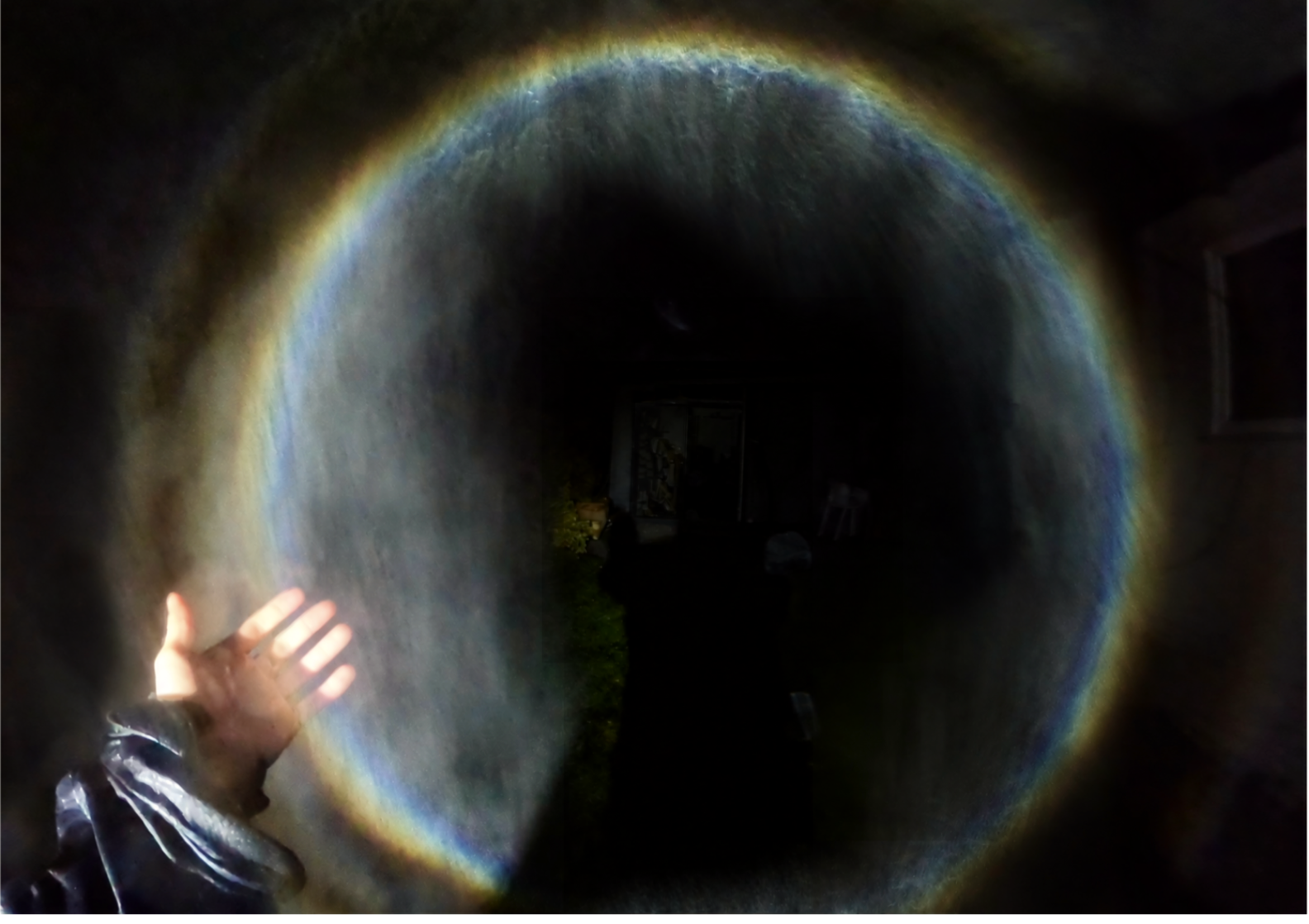
An installation that produces a real circular rainbow around a participant, inspired by the Brocken Spectre or ‘Glory’.
A rainbow exists as a relationship between the sun, droplets, and eyes. That relationship becomes visibly stronger the closer the observer stands to the phenomenon. An enclosed mist environment makes the droplets controllable. Close proximity removes the horizon that normally cuts the rainbow ring in half. Movement lets the participant experience the bow stay centred on them as they walk. Together, these replace the seemingly fixed viewpoint of a distant arc with the observer-centred geometry the physics actually describes.
In All Its Glory introduces the body as an active component in natural systems and investigates the tension between our desire to manipulate nature and the limits of our ability to control it. The project originated from an attempt to recreate the Brocken Spectre, an atmospheric phenomenon in which an observer’s magnified shadow appears against mist, sometimes surrounded by a circular rainbow-like effect known as a glory, whose complex optical behaviour has been proved difficult to reproduce artificially. This work investigates how design can manipulate the conditions of a natural phenomenon while remaining subject to its physical limitations. Rather than treating the difficulty of the reproduction of the glory as a failure, this project considers it an opportunity to recognise the complexity of nature and question whether our attempts to control it might sometimes diminish the qualities that make it extraordinary.
The work attempts to produce a unique phenomenon to replicate the feeling of awe people experience from nature, colour, and light which seems to unite us all. This project explores how design might facilitate an encounter with nature and an engagement with the sublime feeling which is often lost in the modern world, while its effect (the awe of nature) can be momentous in how we value it.
Behind the Work