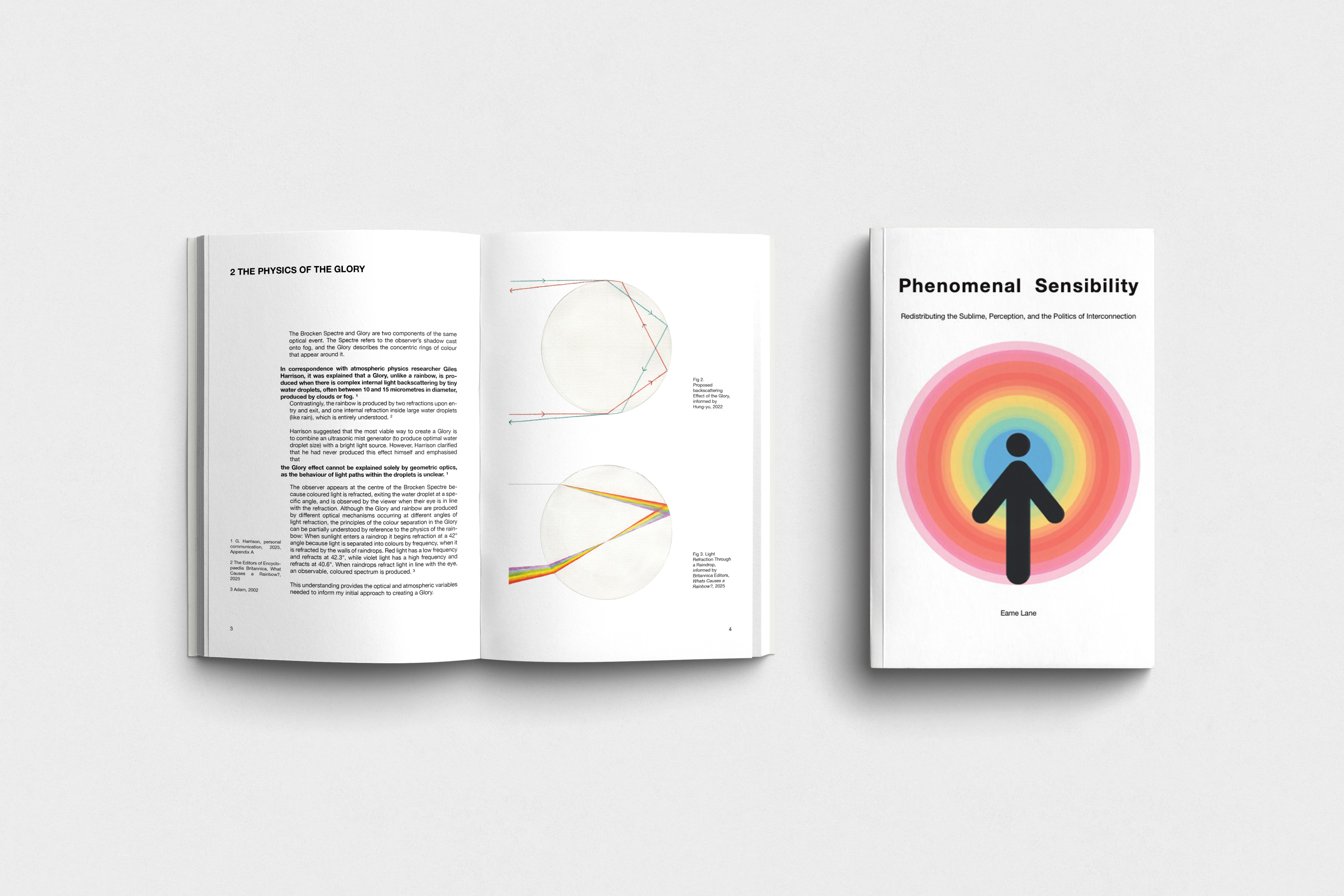
Phenomenal Sensibility (2026)
This report supporting the project In All Its Glory, explores how our perception of natural phenomena can inspire a deeper awareness of the relationship between humans and the environment. Specifically this report investigates this, using designed nature to explore control and surrender in the natural world.
The title reflects my interest in how we experience the world through our senses, and how encounters with extraordinary natural events can challenge our understanding of reality. Through the study of the Brocken Spectre, an atmospheric phenomenon in which an observer’s shadow appears magnified against fog and surrounded by concentric rings of coloured light known as a Glory, I investigate the tension between scientific understanding and the sense of wonder that arises from what remains difficult to explain or reproduce.
I conducted experiments using artificial mist and directed light, attempting to reproduce the optical conditions of the Brocken Spectre. I also corresponded with atmospheric physicist Giles Harrison, whose insights into the behaviour of light within microscopic water droplets helped me understand the scientific complexity of the phenomenon. My initial attempts to recreate the Glory were unsuccessful, revealing limitations in human intervention. Rather than viewing this solely as a technical limitation, I began to question whether attempting to fully reproduce such phenomena might diminish the very qualities that make them extraordinary. Its perceptual ambiguity, unusual visual scale and resistance to straightforward reproduction prompted me to consider the relationship between scientific knowledge, human intervention and the sublime.
Phenomenal Sensibility examines how design might cultivate a heightened sensitivity to the natural world without attempting to fully control or explain it.
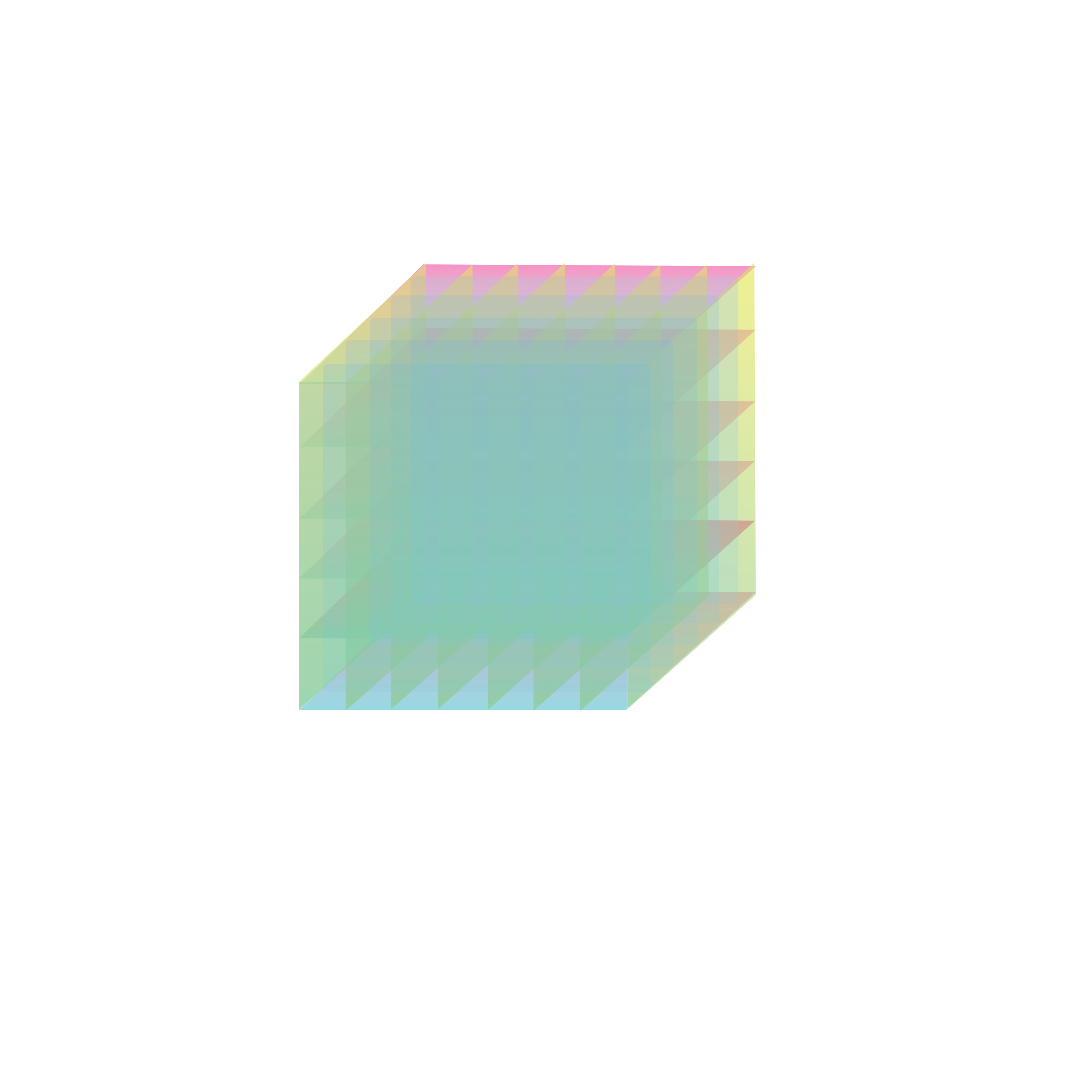
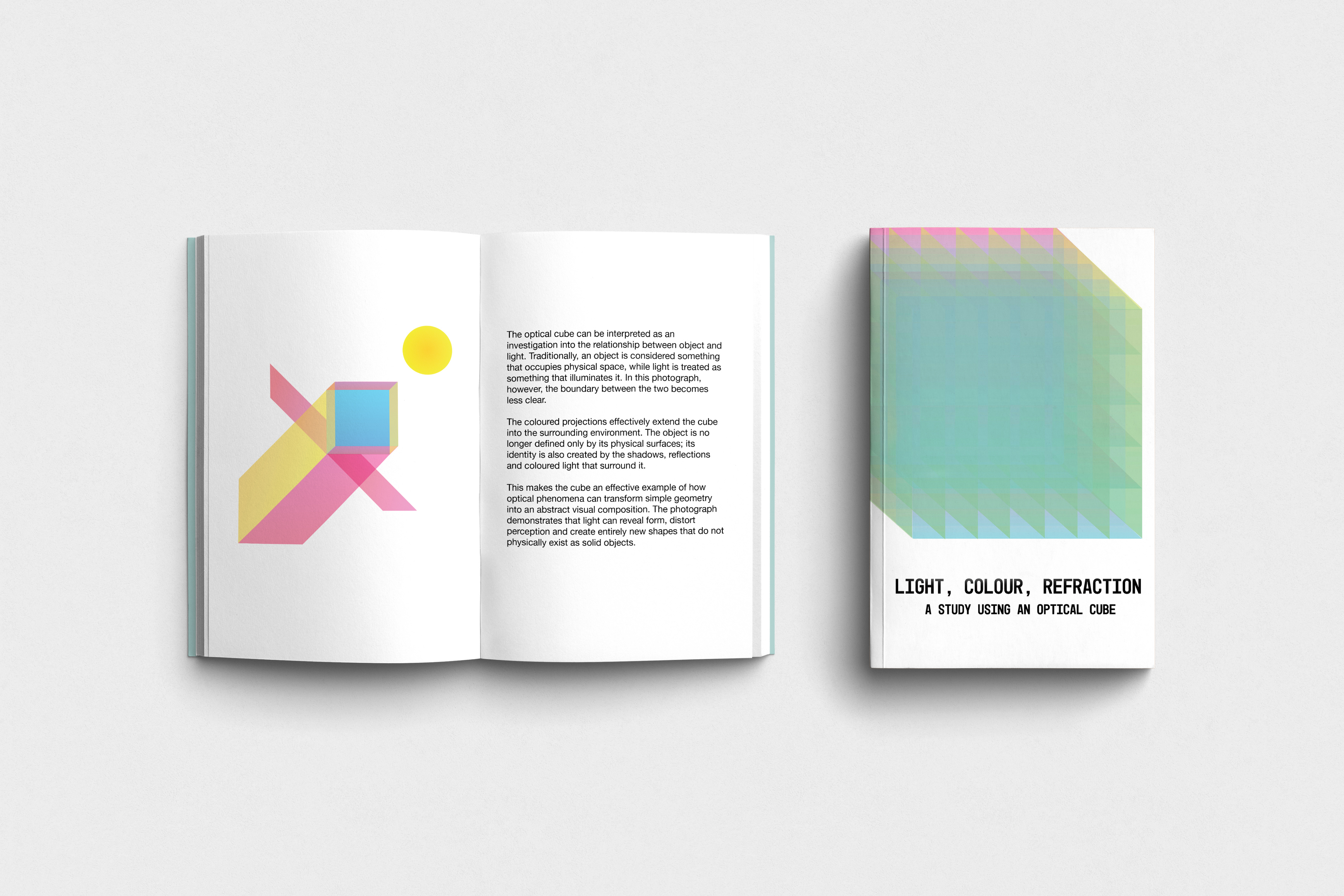
Light, Colour, Refraction:
A Study Using an Optical Cube (2026)
This publication became an important stage in the development of Chroma Halo.
Through this investigation, I began to understand light not simply as a means of illuminating an object, but as a material capable of transforming how an object and its surroundings are perceived.
My philosophical approach was informed by the work of Robert Irwin, whose practice explores the relationship between perception, the artwork, and its surrounding environment. Irwin’s rejection of the artwork as an isolated, fixed object challenged my understanding of how objects might be experienced - transforming encounters with otherwise ordinary materials. This became a starting point for investigating how light might extend the perceived boundaries of an object beyond its physical form.
The investigation began by exploring how light behaves as it passes through transparent materials, focusing on the conditions required to produce spectral colour. Through material experimentation, I examined how illumination, alongside the geometry and optical properties of transparent forms, influenced the formation of colour and projections.
The resulting colours and shadows became an extension of the object itself, making perception dependent on the relationship between material, illumination, and space. Inspired by Irwin’s approach, I became increasingly interested in how these relationships could become the central subject of a work, rather than simply supporting its appearance.
My interest in the natural origins of spectral colour led me to consider the role of water droplets in atmospheric optics. This prompted a transition towards the glass sphere as a form through which natural light is the material focus.
Phenomenal Sensibility (2026)
This report supporting the project In All Its Glory, explores how our perception of natural phenomena can inspire a deeper awareness of the relationship between humans and the environment. Specifically this report investigates this, using designed nature to explore control and surrender in the natural world.
The title reflects my interest in how we experience the world through our senses, and how encounters with extraordinary natural events can challenge our understanding of reality. Through the study of the Brocken Spectre, an atmospheric phenomenon in which an observer’s shadow appears magnified against fog and surrounded by concentric rings of coloured light known as a Glory, I investigate the tension between scientific understanding and the sense of wonder that arises from what remains difficult to explain or reproduce.
I conducted experiments using artificial mist and directed light, attempting to reproduce the optical conditions of the Brocken Spectre. I also corresponded with atmospheric physicist Giles Harrison, whose insights into the behaviour of light within microscopic water droplets helped me understand the scientific complexity of the phenomenon. My initial attempts to recreate the Glory were unsuccessful, revealing limitations in human intervention. Rather than viewing this solely as a technical limitation, I began to question whether attempting to fully reproduce such phenomena might diminish the very qualities that make them extraordinary. Its perceptual ambiguity, unusual visual scale and resistance to straightforward reproduction prompted me to consider the relationship between scientific knowledge, human intervention and the sublime.
Phenomenal Sensibility examines how design might cultivate a heightened sensitivity to the natural world without attempting to fully control or explain it.
Light, Colour, Refraction:
A Study Using an Optical Cube (2026)
This publication became an important stage in the development of Chroma Halo.
Through this investigation, I began to understand light not simply as a means of illuminating an object, but as a material capable of transforming how an object and its surroundings are perceived.
My philosophical approach was informed by the work of Robert Irwin, whose practice explores the relationship between perception, the artwork, and its surrounding environment. Irwin’s rejection of the artwork as an isolated, fixed object challenged my understanding of how objects might be experienced - transforming encounters with otherwise ordinary materials. This became a starting point for investigating how light might extend the perceived boundaries of an object beyond its physical form.
The investigation began by exploring how light behaves as it passes through transparent materials, focusing on the conditions required to produce spectral colour. Through material experimentation, I examined how illumination, alongside the geometry and optical properties of transparent forms, influenced the formation of colour and projections.
The resulting colours and shadows became an extension of the object itself, making perception dependent on the relationship between material, illumination, and space. Inspired by Irwin’s approach, I became increasingly interested in how these relationships could become the central subject of a work, rather than simply supporting its appearance.
My interest in the natural origins of spectral colour led me to consider the role of water droplets in atmospheric optics. This prompted a transition towards the glass sphere as a form through which natural light is the material focus.