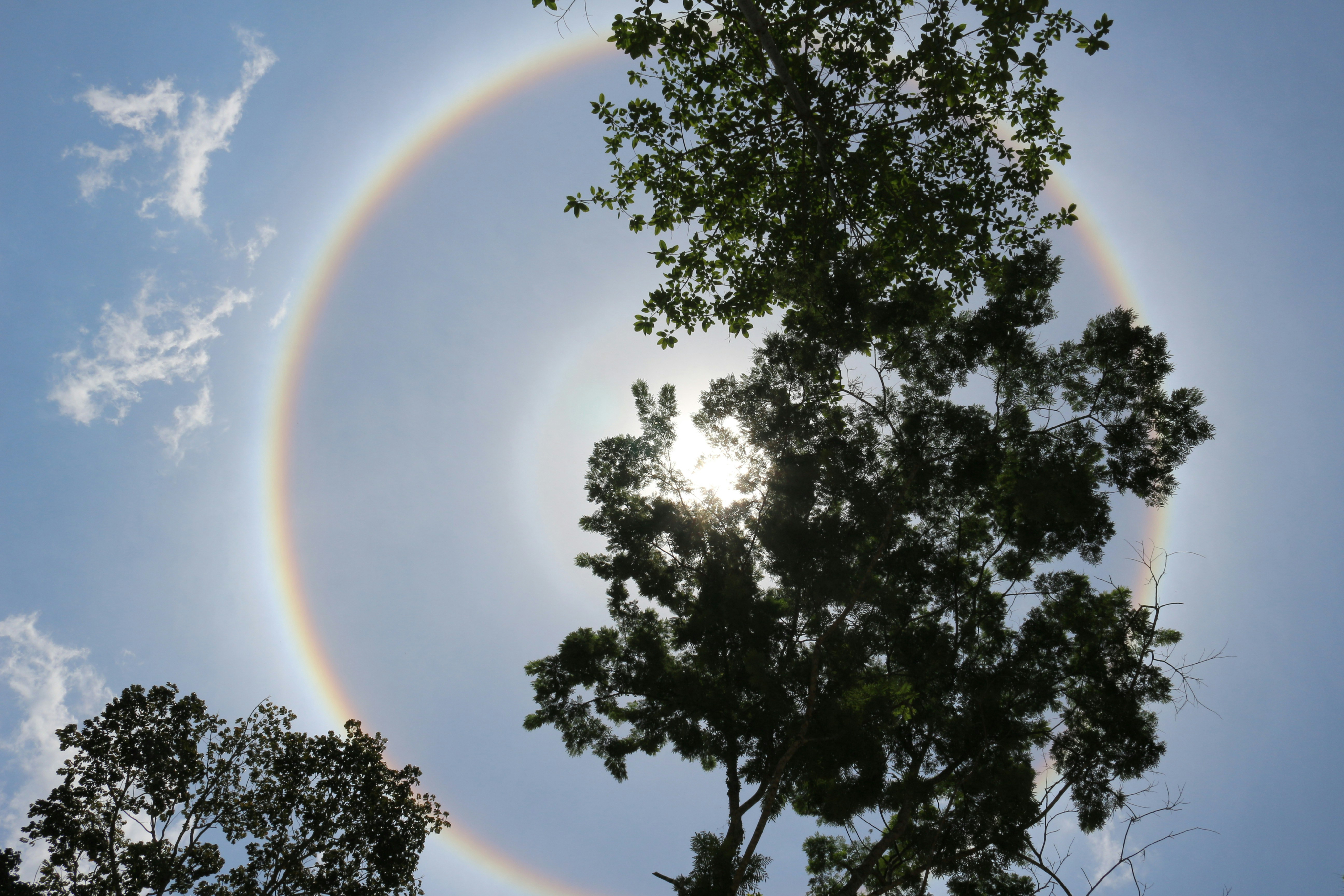
A solar halo is an optical phenomenon that appears when sunlight passes through ice crystals suspended high in the atmosphere, typically within thin cirrus clouds. It most commonly appears as a bright, luminous ring surrounding the Sun, formed when light is refracted and reflected through the angled faces of the ice crystals. The crystals act like tiny prisms, bending sunlight and separating it into subtle spectral colours, although the halo often appears predominantly white with hints of red and blue around its edges. Like a rainbow, the phenomenon depends on a specific relationship between the light source, atmospheric conditions and the observer’s position. The halo can make the Sun appear surrounded by an unexpected geometric structure, transforming an otherwise familiar view of the sky into something visually unfamiliar and extraordinary.
Chroma Halo (2026)
Chroma Halo developed from an interest in the point at which light becomes material, informed by Robert Irwin’s philosophical approach to perception and his exploration of the relationship between an artwork, its surroundings and the viewer.
Inspired by Irwin’s understanding of perception as an active experience shaped by environmental conditions, Chroma Halo shifts the focus from the object to the visual relationships it creates. Through this investigation, the work seeks to transform a simple optical arrangement into an encounter with the extraordinary.
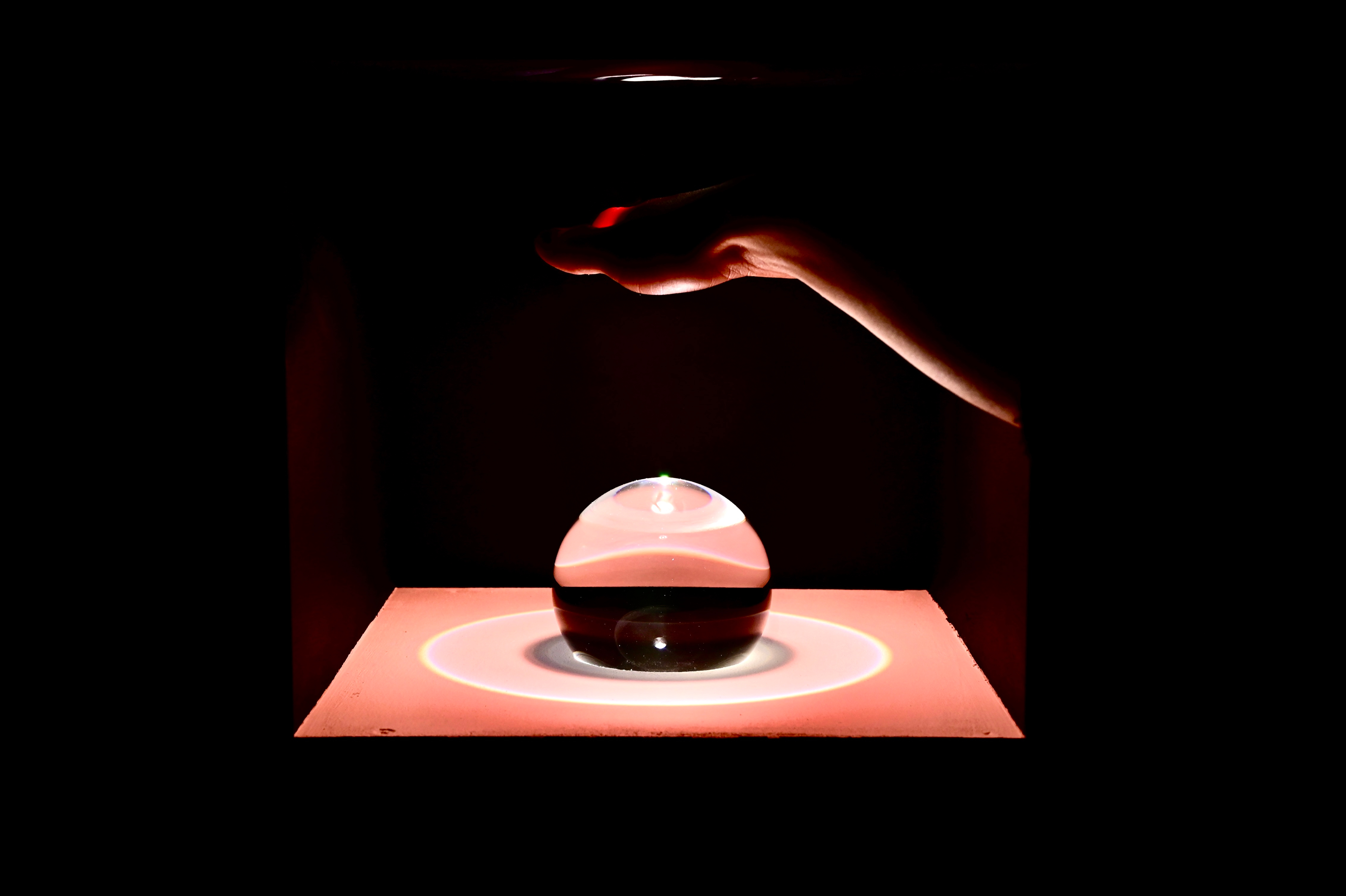
A key aspect of Chroma Halo is the ability to alter the colour of the sculpture through light reflected from the viewer’s hand. This introduces the body as an active component of the optical system, allowing the viewer’s movement and interaction to influence the appearance of the spectral halo, challenging the idea of the sculpture as a fixed object. The mechanism is grounded in physical principles rather than digital simulation, allowing the phenomenon to emerge through the behaviour of light itself.
This work developed my investigation into the tension between control and surrender in nature: how we can manipulate natural principles through design while remaining subject to the physical laws and conditions that govern them. The work aims to celebrate the extraordinary complexity of nature, encouraging a deeper appreciation of its beauty while recognising that its inherent limitations should be respected rather than overcome.
Light, Colour, Refraction:
A Study Using an Optical Cube (2026)
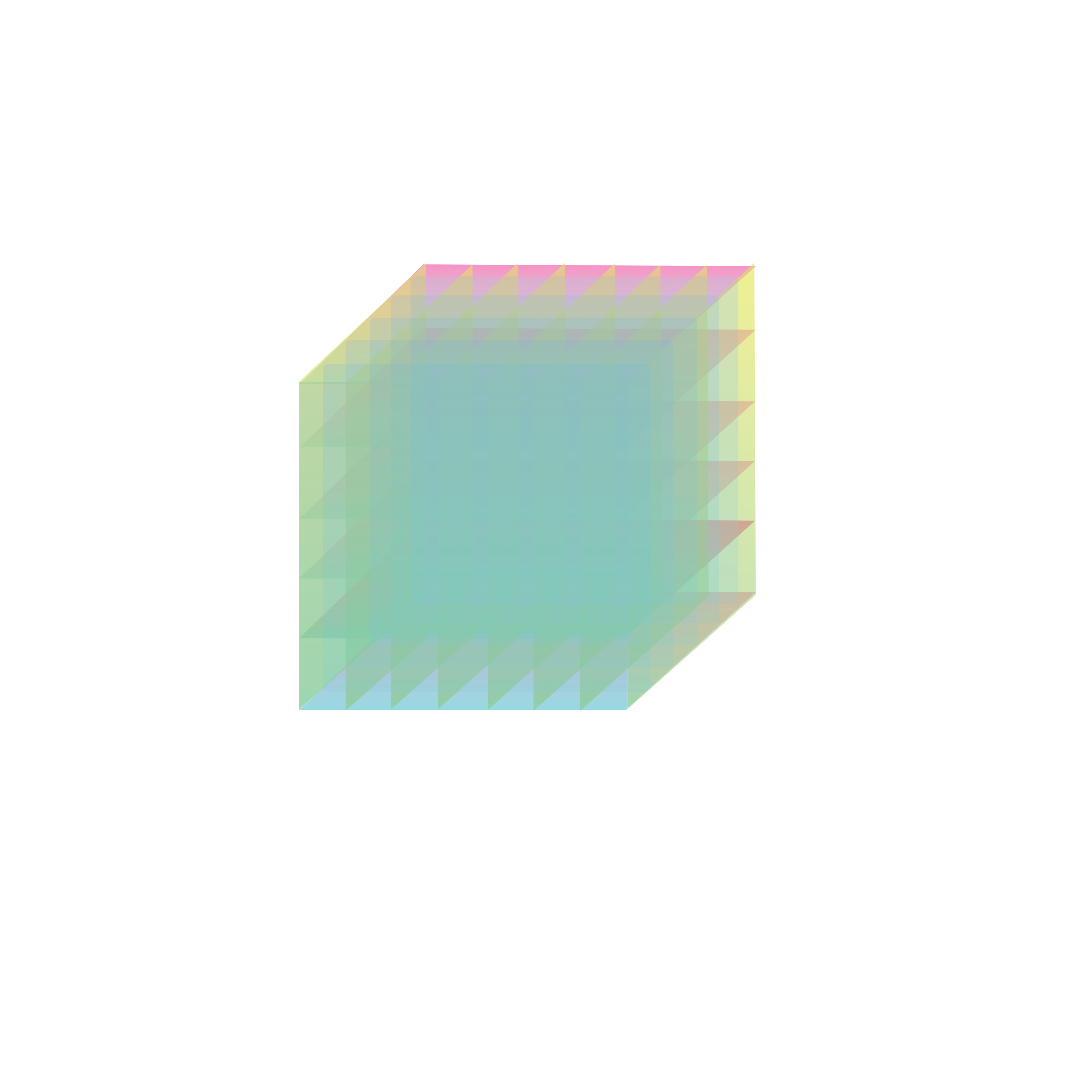
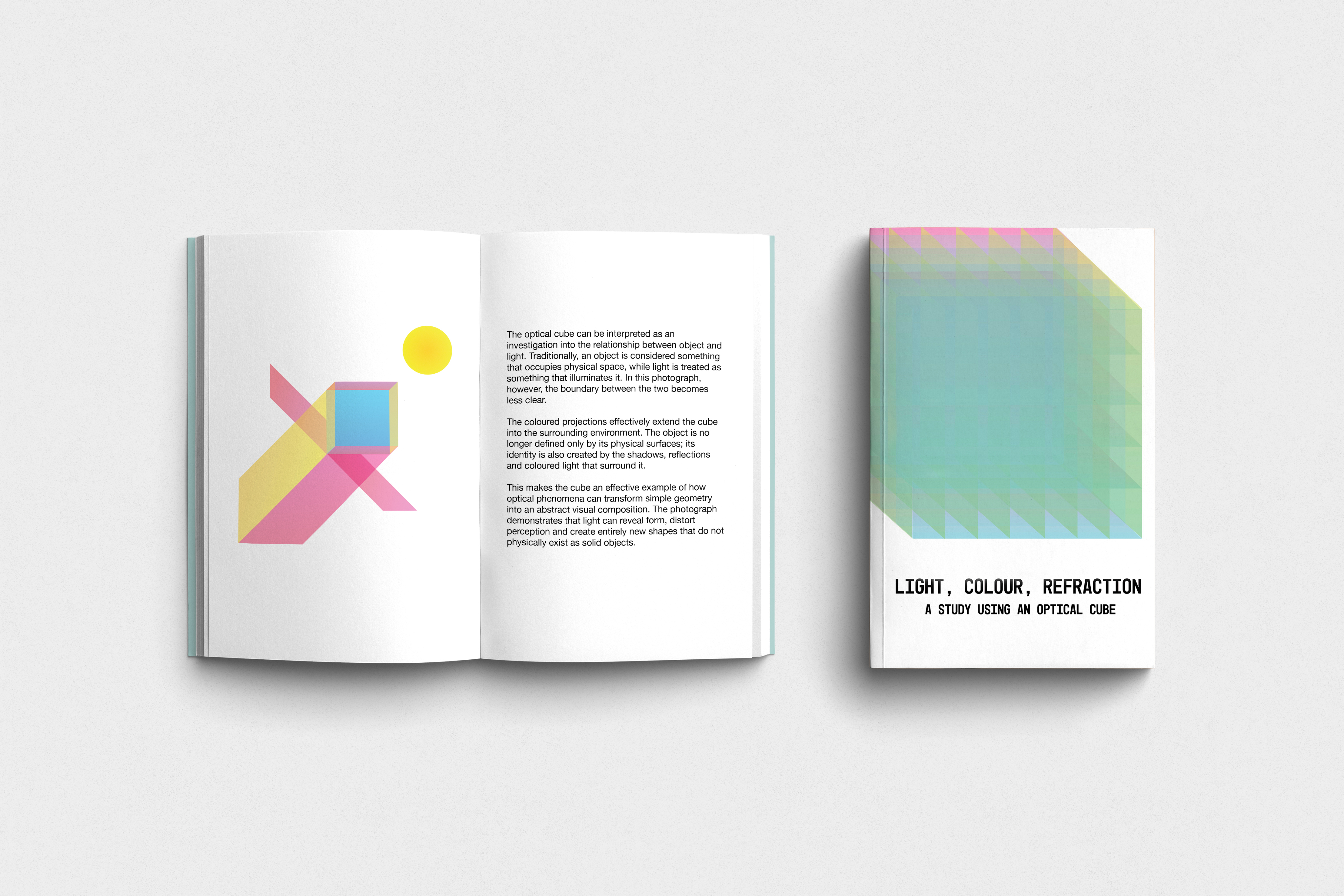
The publication Light, Colour, Refraction: A Study Using an Optical Cube (2026) investigates light behaviour as it passes through an optical cube, focusing on the conditions required to extend the material object and produce spectral colour. Through experimentation, I examined how illumination, alongside the geometry and optical properties of transparent forms, influenced the formation of colour and projections.
My interest in the natural origins of spectral colour led me to consider the role of water droplets in atmospheric optics. This prompted a transition towards the glass sphere as a form through which natural light is the material focus.
The resulting work acts as an abstraction of atmospheric optics, drawing on the visual and perceptual qualities of a solar halo. By translating these qualities into a sculptural object, I sought to make the transformation of spectral light accessible to direct observation and manipulation. The glass sphere allows the viewer to encounter iridescent colour at close range and alter its appearance through movement.
Through this publication, I began to understand how scientific investigation, material experimentation and perceptual inquiry could inform a more philosophical approach to design. These ideas established an important foundation for my wider investigation into atmospheric phenomena and the tension between scientific understanding and the sense of wonder that emerges when light behaves in unexpected ways.
A solar halo is an optical phenomenon that appears when sunlight passes through ice crystals suspended high in the atmosphere, typically within thin cirrus clouds. It most commonly appears as a bright, luminous ring surrounding the Sun, formed when light is refracted and reflected through the angled faces of the ice crystals. The crystals act like tiny prisms, bending sunlight and separating it into subtle spectral colours, although the halo often appears predominantly white with hints of red and blue around its edges. Like a rainbow, the phenomenon depends on a specific relationship between the light source, atmospheric conditions and the observer’s position. The halo can make the Sun appear surrounded by an unexpected geometric structure, transforming an otherwise familiar view of the sky into something visually unfamiliar and extraordinary.
Chroma Halo (2026)
Chroma Halo developed from an interest in the point at which light becomes material, informed by Robert Irwin’s philosophical approach to perception and his exploration of the relationship between an artwork, its surroundings and the viewer.
Inspired by Irwin’s understanding of perception as an active experience shaped by environmental conditions, Chroma Halo shifts the focus from the object to the visual relationships it creates. Through this investigation, the work seeks to transform a simple optical arrangement into an encounter with the extraordinary.
A key aspect of Chroma Halo is the ability to alter the colour of the sculpture through light reflected from the viewer’s hand. This introduces the body as an active component of the optical system, allowing the viewer’s movement and interaction to influence the appearance of the spectral halo, challenging the idea of the sculpture as a fixed object. The mechanism is grounded in physical principles rather than digital simulation, allowing the phenomenon to emerge through the behaviour of light itself.
This work developed my investigation into the tension between control and surrender in nature: how we can manipulate natural principles through design while remaining subject to the physical laws and conditions that govern them. The work aims to celebrate the extraordinary complexity of nature, encouraging a deeper appreciation of its beauty while recognising that its inherent limitations should be respected rather than overcome.
Light, Colour, Refraction:
A Study Using an Optical Cube (2026)
The publication Light, Colour, Refraction: A Study Using an Optical Cube (2026) investigates light behaviour as it passes through an optical cube, focusing on the conditions required to extend the material object and produce spectral colour. Through experimentation, I examined how illumination, alongside the geometry and optical properties of transparent forms, influenced the formation of colour and projections.
My interest in the natural origins of spectral colour led me to consider the role of water droplets in atmospheric optics. This prompted a transition towards the glass sphere as a form through which natural light is the material focus.
The resulting work acts as an abstraction of atmospheric optics, drawing on the visual and perceptual qualities of a solar halo. By translating these qualities into a sculptural object, I sought to make the transformation of spectral light accessible to direct observation and manipulation. The glass sphere allows the viewer to encounter iridescent colour at close range and alter its appearance through movement.
Through this publication, I began to understand how scientific investigation, material experimentation and perceptual inquiry could inform a more philosophical approach to design. These ideas established an important foundation for my wider investigation into atmospheric phenomena and the tension between scientific understanding and the sense of wonder that emerges when light behaves in unexpected ways.