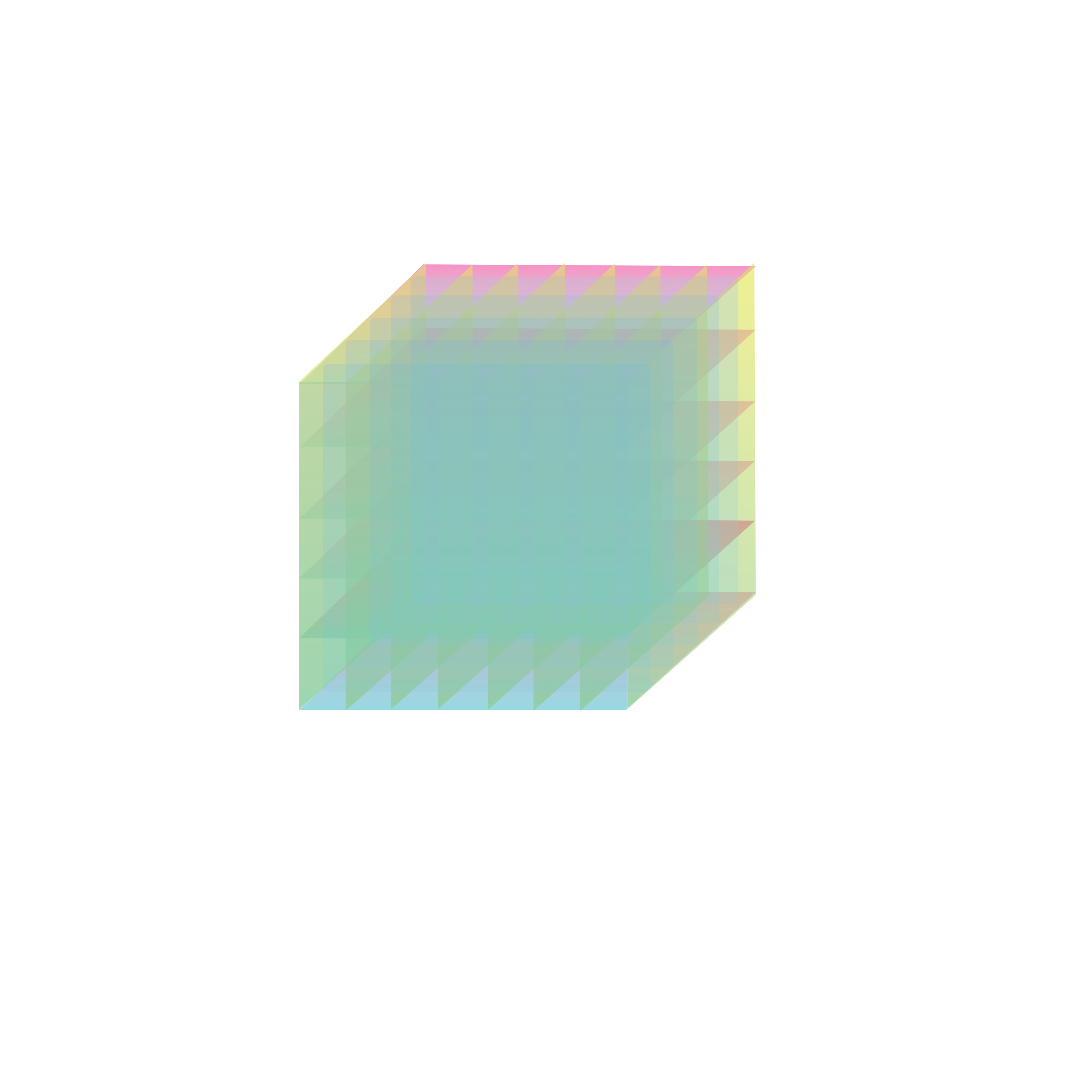
Light, Colour, Refraction:
A Study Using an Optical Cube (2026)
This publication became an important stage in the development of Chroma Halo.
Through this investigation, I began to understand light not simply as a means of illuminating an object, but as a material capable of transforming how an object and its surroundings are perceived.
My philosophical approach was informed by the work of Robert Irwin, whose practice explores the relationship between perception, the artwork, and its surrounding environment. Irwin’s rejection of the artwork as an isolated, fixed object challenged my understanding of how objects might be experienced - transforming encounters with otherwise ordinary materials. This became a starting point for investigating how light might extend the perceived boundaries of an object beyond its physical form.
The investigation began by exploring how light behaves as it passes through transparent materials, focusing on the conditions required to produce spectral colour. Through material experimentation, I examined how illumination, alongside the geometry and optical properties of transparent forms, influenced the formation of colour and projections.
The resulting colours and shadows became an extension of the object itself, making perception dependent on the relationship between material, illumination, and space. Inspired by Irwin’s approach, I became increasingly interested in how these relationships could become the central subject of a work, rather than simply supporting its appearance.
My interest in the natural origins of spectral colour led me to consider the role of water droplets in atmospheric optics. This prompted a transition towards the glass sphere as a form through which natural light is the material focus.
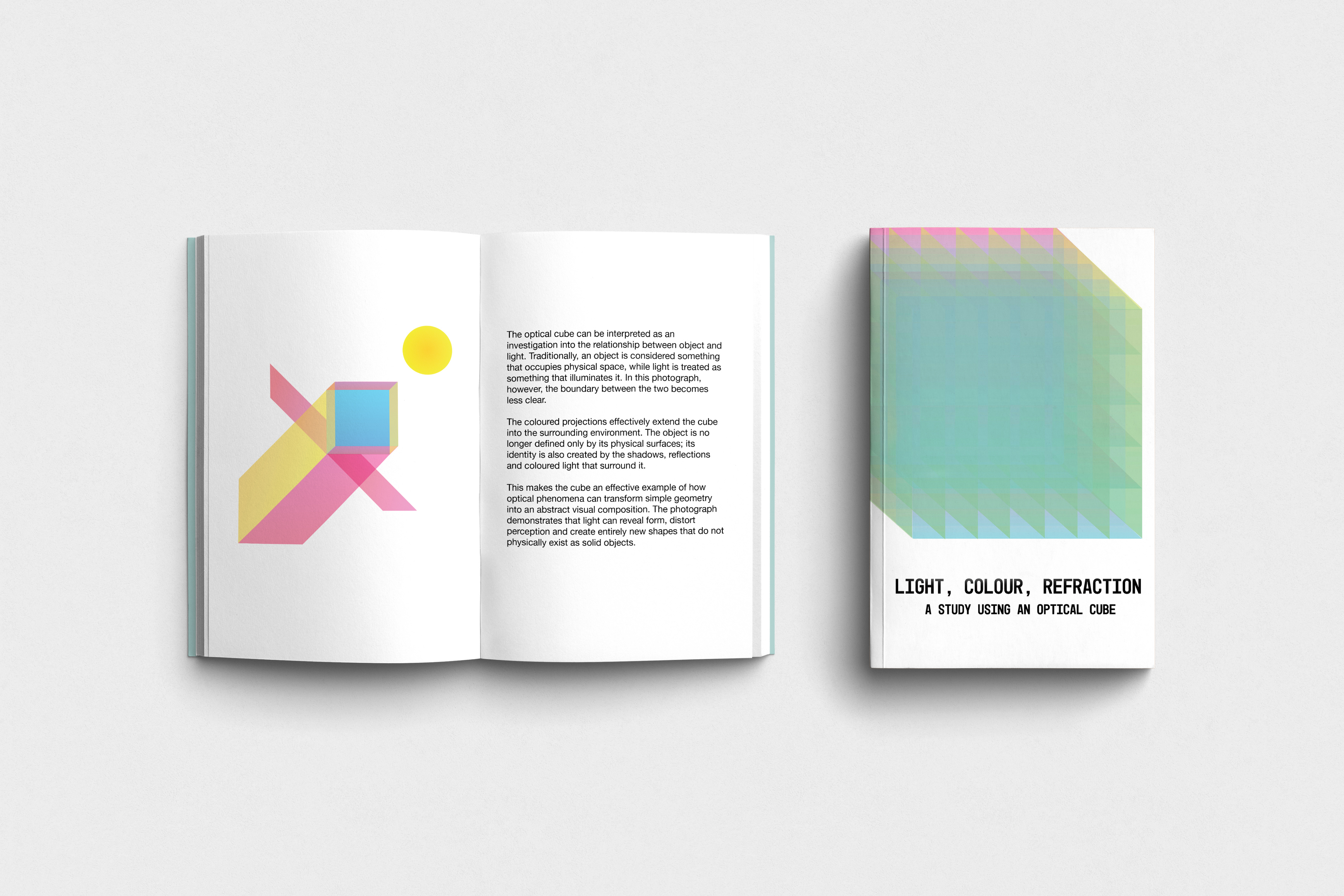
Light, Colour, Refraction:
A Study Using an Optical Cube (2026)
This publication became an important stage in the development of Chroma Halo.
Through this investigation, I began to understand light not simply as a means of illuminating an object, but as a material capable of transforming how an object and its surroundings are perceived.
My philosophical approach was informed by the work of Robert Irwin, whose practice explores the relationship between perception, the artwork, and its surrounding environment. Irwin’s rejection of the artwork as an isolated, fixed object challenged my understanding of how objects might be experienced - transforming encounters with otherwise ordinary materials. This became a starting point for investigating how light might extend the perceived boundaries of an object beyond its physical form.
The investigation began by exploring how light behaves as it passes through transparent materials, focusing on the conditions required to produce spectral colour. Through material experimentation, I examined how illumination, alongside the geometry and optical properties of transparent forms, influenced the formation of colour and projections.
The resulting colours and shadows became an extension of the object itself, making perception dependent on the relationship between material, illumination, and space. Inspired by Irwin’s approach, I became increasingly interested in how these relationships could become the central subject of a work, rather than simply supporting its appearance.
My interest in the natural origins of spectral colour led me to consider the role of water droplets in atmospheric optics. This prompted a transition towards the glass sphere as a form through which natural light is the material focus.